
With Bad Bunny still riding high from his historic Super Bowl Halftime Show performance and BTS back in full force, it’s clear to even casual U.S. music listeners that a cultural shift is underway. The industry is more global than ever, which has allowed international artists to reach a level of global recognition historically reserved for English-speaking acts.
As a result of these worldwide trends, Luminate data confirms that the American music landscape is evolving from a domestic-centric market into a vibrant international crossroads. While U.S. artists still claim the majority of consumption (roughly 2 in 3 U.S. On-Demand Audio streams are by American artists), that dominance is steadily eroding each year.
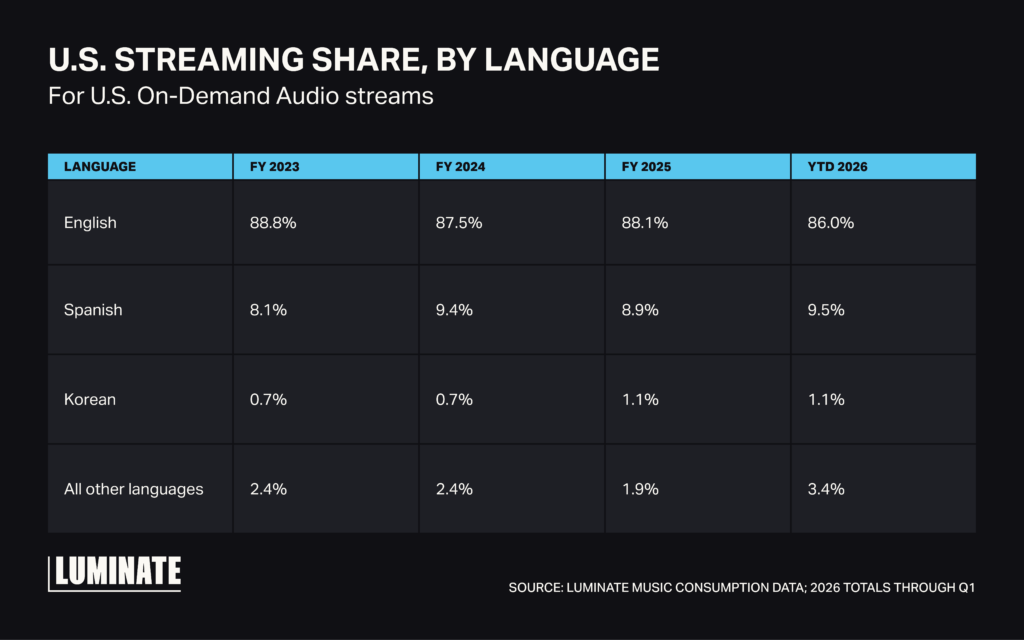
Through Q1 2026, English-language music consumption in the U.S. fell by 2.1 share points compared with Q1 2025 (86% and 88.1%, respectively), continuing a long-term downward trend as global sounds capture American ears.
Leading this charge is Spanish-language music, which accounted for nearly 1 in 10 ODA streams in the U.S., reaching a historic 9.5% market share through the first quarter.
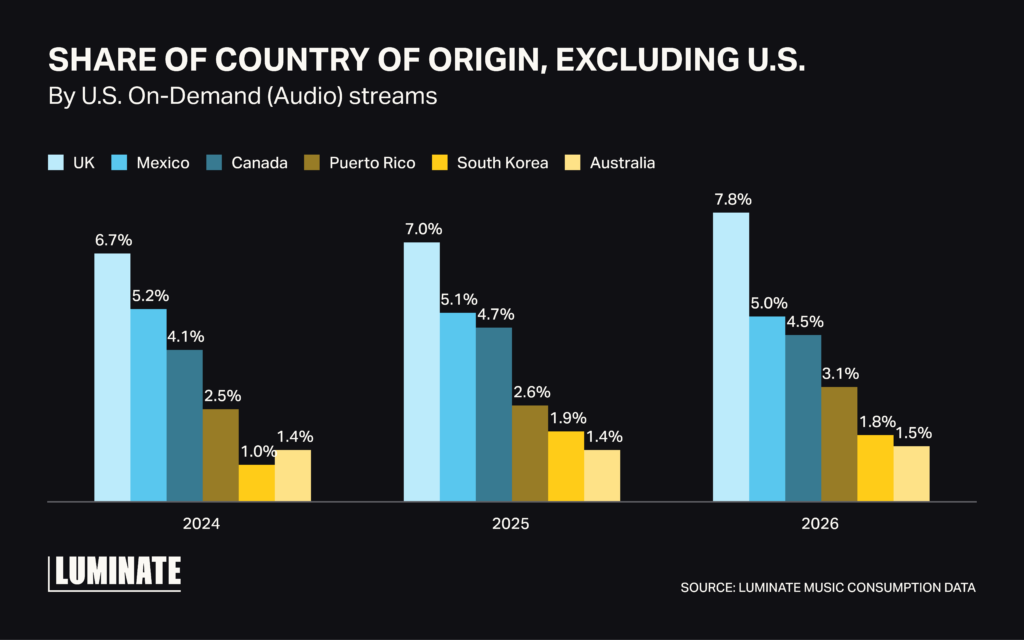
This explosive growth is heavily anchored by megastars including Bad Bunny, who has driven Puerto Rico’s streaming share up by 0.5 points and stands as the #2 overall ranked artist in the U.S. throughout Q1 2026. In fact, his Super Bowl performance propelled the Latin music genre overall to an all-time high of 2.74 billion weekly U.S. ODA streams for the week ending Feb. 12, 2026.
In other words, Latin music has fully shattered its “niche” status in the U.S., and recent Luminate Insights consumer research data confirms that notion. While die-hard and weekly fanbases of the genre have held steady, casual monthly listenership of Latin music has grown consistently, climbing from 41% in early 2024 to 56% in Q1 2026. That increase means more than half of U.S. listeners now count Latin as a genre they listen to casually.
But this diversification extends far beyond the Latin genre. In Q1 2026, Korean-language streaming held strong at a 1.1% market share, fueled by K-pop sensations including BTS. All other languages outside of English, Spanish and Korean surged to 3.4% of total streams, a substantial 1.5 sharepoint increase over 2025.
Additionally, international territories are steadily chipping away at U.S. dominance in the U.S. market, with the UK gaining 0.8 sharepoints so far this year (led by artists such as Olivia Dean), alongside notable market gains including Australia (led by Tame Impala) and Sweden (led by Zara Larsson).
As for why these shifts matter, the fragmentation of the U.S. streaming market carries strong implications for the entire music ecosystem. Historically, the U.S. acted as a gatekeeper, requiring international artists to adapt to Western styles or sing in English to find commercial success. Today’s streaming infrastructure allows fans to discover music organically, with language not a barrier to entry but rather a point of connection.
For labels, A&R teams can no longer rely purely on localized talent pools.To stay competitive, labels must invest in international scouting, cross-border collaborations and multilingual marketing strategies to mirror changing consumer habits.
As casual listenership for international genres such as Latin music reaches a 56% majority, corporate advertisers must adapt. Marketing campaigns, festival lineups and brand partnerships will increasingly need to reflect a multicultural, polyglot demographic to resonate with American consumers.
The future of music streaming is no longer monolithic. It is global, diverse and uniquely decentralized. Want more in-depth analysis of 2026 entertainment trends? Watch for the Luminate Midyear Report, releasing on Wednesday, July 15.