

The entirety of Luminate’s latest report, Release Strategies for Music & TV, hinges on a simple truth: Making art is hard, but getting people to care about, let alone notice your art, is even harder.
In a streaming-centric, post-monoculture world, the ways to effectively reach people have vastly changed since even a decade ago. That’s where a well-crafted promotional rollout comes in.
In many ways, a successful release strategy for an album in 2026 comes down to an artist’s individual brand, what resonates with fans and what they hope to accomplish both professionally and artistically.
In other words, there’s no right way to do an album rollout. That fact is particularly clear when comparing recent albums by Sabrina Carpenter and Hayley Williams — two artists who took polar-opposite approaches to releasing their respective breakthrough records.
Carpenter achieved massive success in 2024 with her sixth album, Short n’ Sweet. While the virality of singles “Espresso” and “Please Please Please” on social platforms including TikTok was a major boost, Carpenter and her team also utilized a traditional rollout approach — several singles released ahead of the album, with plenty of media promotion in between — to gain momentum ahead of the release via offline channels such as radio and print media.
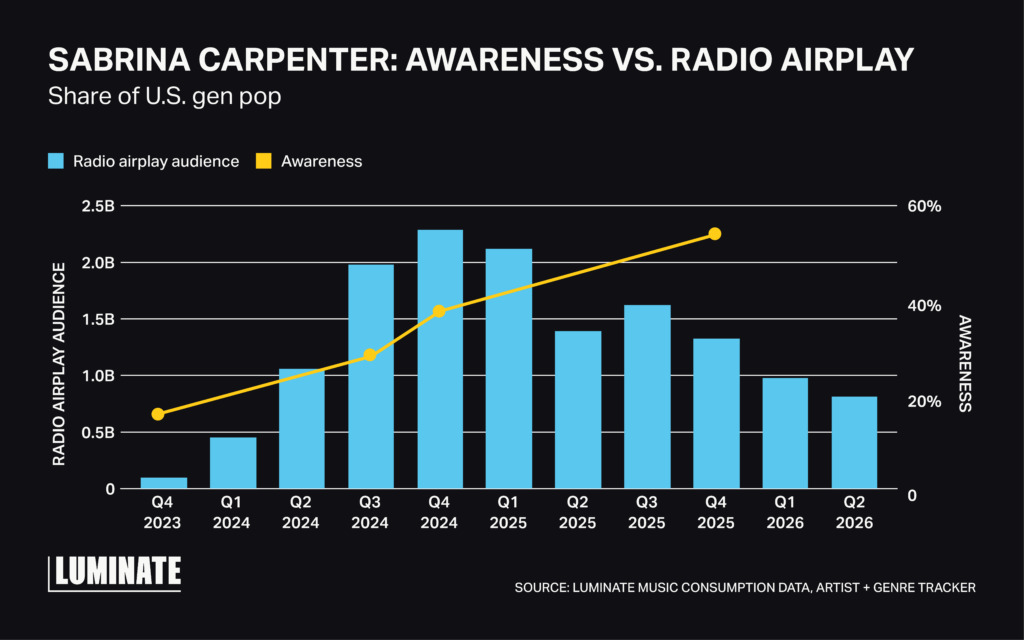
Even in the streaming era, airplay can be key for driving greater awareness and cultural cachet. Luminate data confirmed that the radio push boosted Carpenter’s awareness among the U.S. general population alongside her massive gains in streaming consumption following Short n’ Sweet’s release, jumping from 16% to 55% in just two years, according to Luminate’s Artist + Genre Tracker. Her follow-up album, Man’s Best Friend, arrived just a year after Short n’ Sweet and utilized a similar but shorter traditional rollout.
If Carpenter’s goal for her recent albums was to grow her fanbase and hit a new level of stardom, then the calculated old-school rollout strategy accomplished that. In contrast, Hayley Williams’ latest solo album, Ego Death at a Bachelorette Party, used a chaotic but compelling release strategy that ultimately accomplished the same thing.
The rollout worked in part because it was authentic to where Williams was in her life and career. The album was not only the singer’s deeply personal account of heartbreak and the painful but necessary growth process, but it was also one of her few releases outside of her band Paramore and the first after her 20-year contract with Atlantic Records ended.
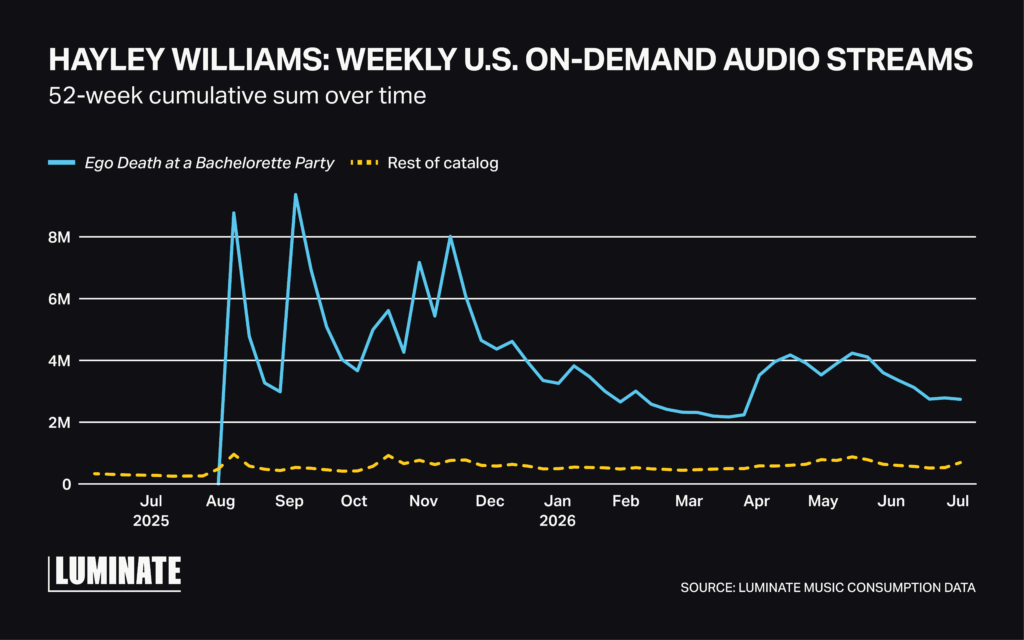
Ego Death, in fact, was initially released on her website in July 2025 as 17 individual songs. The tracks, along with vaguely related videos, images and audio clips, were only available via a code fans could get by purchasing the “Ego” hair dye shade from Williams’ company Good Dye Young.
The songs were removed from the website and uploaded to DSPs as 17 individual singles on Aug. 1, with the goal of encouraging fans to create their own track orders. Williams continued adding new tracks to Ego Death even after it was officially released on Aug. 28, resulting in numerous streaming spikes.
Check out the full Luminate report to see other artists’ notable album release strategies, as well as how release cadences impact the TV industry in the SVOD era.
