
The Red Hot Chili Peppers sold its publishing catalog to Hipgnosis Songs Fund back in 2021 for an estimated $140 million-$150 million, making the Southern California icons one of several artists that year to land nine-figure deals amid a music catalog gold rush.
Five years later, the music catalog industry is still booming, and RHCP has struck another deal, this time selling its recording rights to Warner Music Group for over $300 million. In other words, the band made a ton of money off its music, and Luminate data offers a glimpse as to how RHCP managed to pull off an even bigger deal than it did the first time.
First, some caveats: Music catalog valuations are intensive endeavors involving numerous experts with their own confidential procedures. Furthermore, the music rights industry continued to surge in the years between RHCP’s deals, which partly explains how the band was paid significantly more the second time around. And it’s currently unclear if the latest deal included name, image and likeness (NIL) rights, which would bring their own value into the mix.
Yet even with these unknowns, Luminate data can help assess the most critical factors for valuation: streaming performance, fan habits and genre market trends. Given that the Red Hot Chili Peppers is among the biggest alternative bands working today, these stats offer a uniquely clean-cut case study for the type of artists that can command such high-value deals.
On that note, an artist’s enduring popularity is a major factor in catalog deals. As total U.S. On-Demand Audio (ODA) streams have increased substantially since 2023, RHCP’s market share has grown in tandem — and actually outpaces the total market’s trajectory at present.
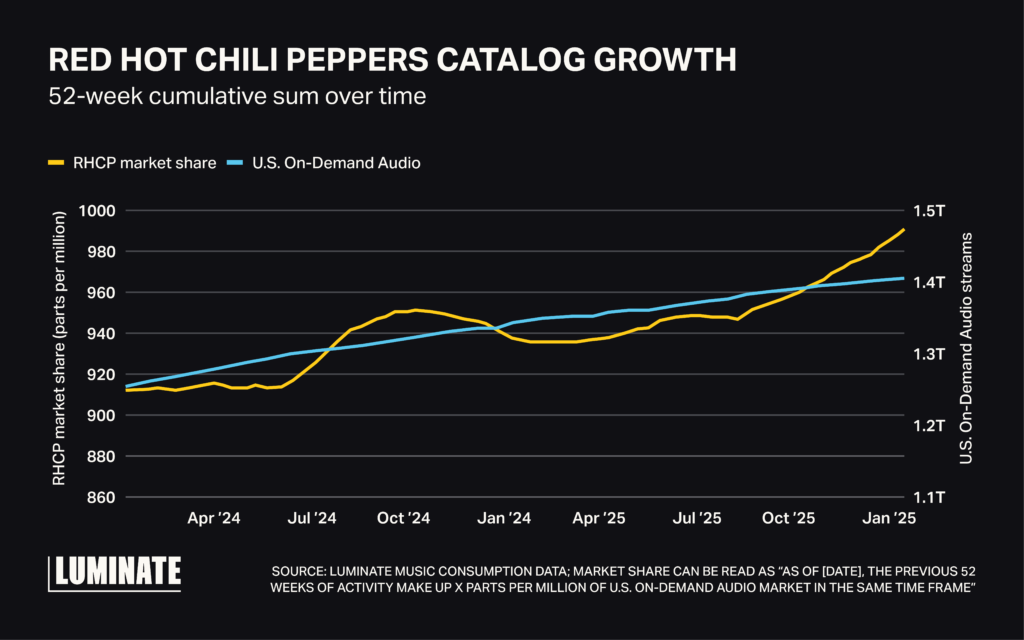
Globally, 66% of RHCP streams come from outside the U.S., notably Brazil, the U.K., Mexico and Australia. That ability to bridge geographic and linguistic barriers suggests the band’s appeal could continue to grow and reach new audiences over time.
These trends are no small feat in an ecosystem where billions of streams of new music are added every day and where the norm, even for successful music, is to lose market share over time. Even without releasing new music since 2022, RHCP has been able to remain ubiquitous.
While streaming volume is important in catalog deals, it isn’t the only consumption trend that plays into catalog valuations.The ratio of premium to ad-supported streams is also key, as the former earns higher royalties than the latter. Additionally, the concentration of streams across an artist’s catalog is a major factor — a more evenly distributed catalog may present more monetary opportunities than a catalog, where the majority of streams come from only one or two hits.
RHCP excels on these fronts: 91% of the band’s U.S. ODA streams were premium in 2025, above the total U.S. market’s ODA premium share of 88%. In other words, each stream on a Chili Peppers song earns more royalties than the average U.S. stream. To that point, RHCP fans in general are extra engaged in the band — 56% of U.S. fans would purchase a concert ticket, while 68% would tune in for a TV performance, per Luminate’s Artist + Genre Tracker.
And in terms of distribution, the band’s top five songs make up a little over half their total streams, while the rest of its back catalog brings in 48.8%.
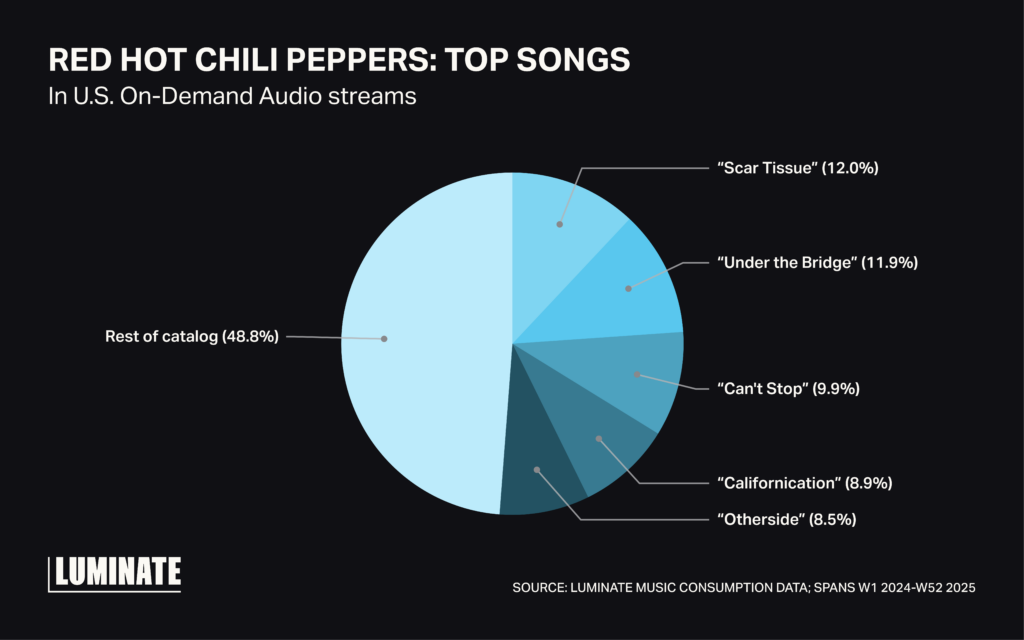
Such a distribution indicates revenue on the catalog is not reliant on the success of the band’s biggest hits and that the wider discography can be just as valuable. For reference, RHCP’s streaming splits are similar to that of Slipknot, which sold its catalog rights for a reported $120 million last fall. Even as the metal act brings in smaller stream counts than RHCP, the fact that its deep cuts brought in nearly 60% of the group’s streams was likely appealing to buyers.
Download Luminate’s free Music Rights & Catalog Acquisitions report to learn more about the booming market and how Luminate data is pivotal in catalog valuations.