
With the never-ending saga that is the Paramount-Warner Bros. Discovery deal finally heading toward an antitrust trial scheduled for March 2027, rest assured the merits of the case will be debated in the court of public opinion right up until then.
But the focus of the debate has largely centered on whether the merged company’s holdings in theatrical films and cable networks reach problematic levels. Those areas are where the coalition of attorneys general representing 12 states has focused its lawsuit, which is separate from the legal action taken by the Writers Guild of America to block the merger.
What has managed to stay out of the spotlight is Paramount and WBD’s respective streaming assets, which are expected to be combined in some fashion, though Paramount hasn’t yet indicated how exactly that will work.
What little has been expressed to date on the subject by Paramount CEO David Ellison actually indicated he is not seeking to diminish the HBO brand. Still, that doesn’t necessarily mean HBO Max will continue to operate as an entity independent of Paramount+. HBO could just as easily remain a distinct subsection within the Paramount streamer.
But as powerful a force in any form as HBO Max and Paramount+ could be, uniting more than 200 million SVOD subscribers under the same company, there is good reason streaming isn’t being put in the antitrust crosshairs. The streaming category’s dominant players will still maintain a healthy lead over a “ParaMax” hybrid but certainly vault it higher in any kind of ranking to be more competitive with the likes of Netflix or Disney+.
Seen through the lens of the latest Nielsen Gauge report tracking streaming market share from May 2026, a ParaMax combo doesn’t amount to that meaningful a duo. With Paramount+ registering a 2.5% share and HBO Max at 1.3%, a 3.8% share would still put a ParaMax at a distant fourth among SVOD market entrants. (Fourth-place Prime Video is at 4.5%.)
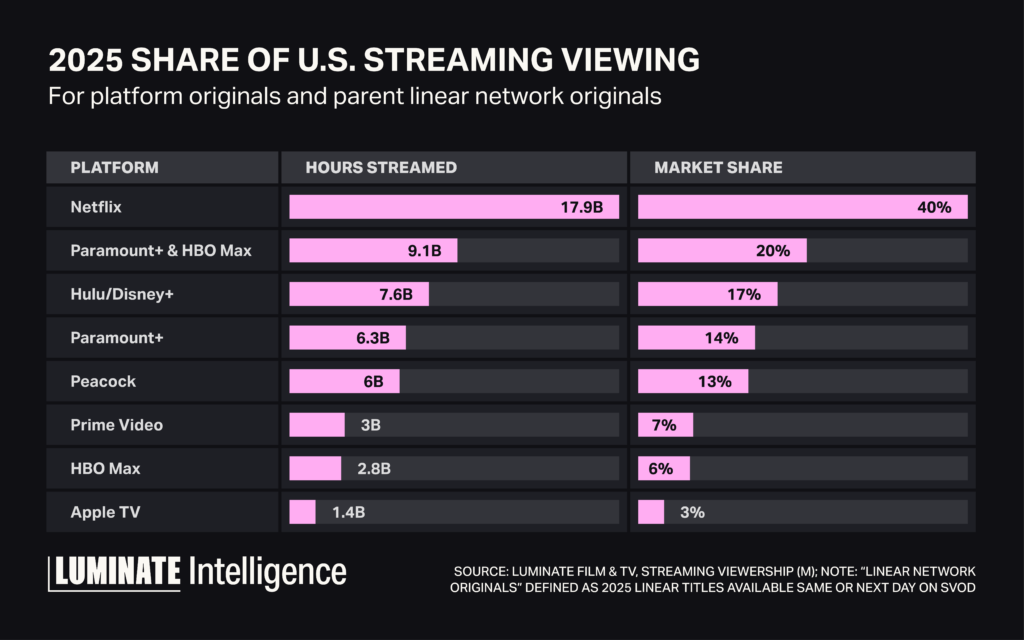
Luminate offers a different lens through which to assess the strength of the ParaMax offering, with share of U.S. streaming viewing for 2025 demonstrating a significant boost. Paramount+ has a 14% share by that measure; combined with an additional 6% from HBO Max, that 20% share would put ParaMax in second place, ahead of Hulu/Disney+, Peacock, Prime Video and Apple TV.
Should it be the kind of jump that should alarm state attorneys general? Hardly. Netflix would still have double the market share of the 20% ParaMax would muster. While it’s an improved standing worth taking into consideration when assessing the value of a post-merger streaming strategy, it’s hardly something that rises to a level that would concern regulators.