
Most consumers want to know when generative AI was used in content creation. Media consumers say they want platforms, studios or creators to disclose if AI was used to meaningfully contribute to entertainment content, according to three separate surveys that asked about preferences toward AI transparency in music, TV shows or movies and video games.
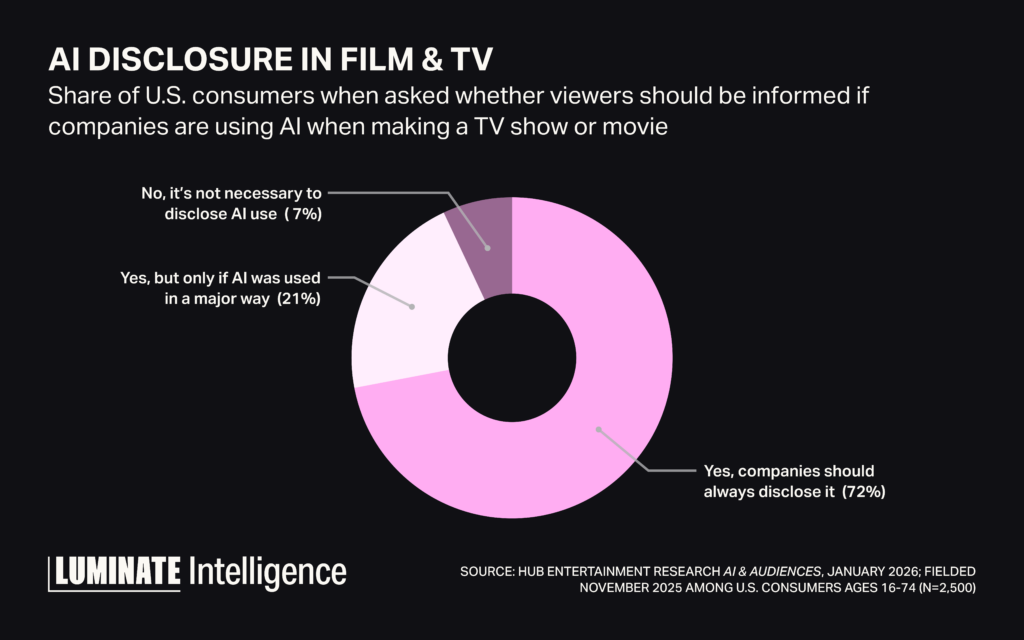
Fully 93% of U.S. consumers felt viewers should be informed if companies use AI when making a TV show or movie, with 72% saying companies should always disclose any AI use, according to Hub Entertainment Research.
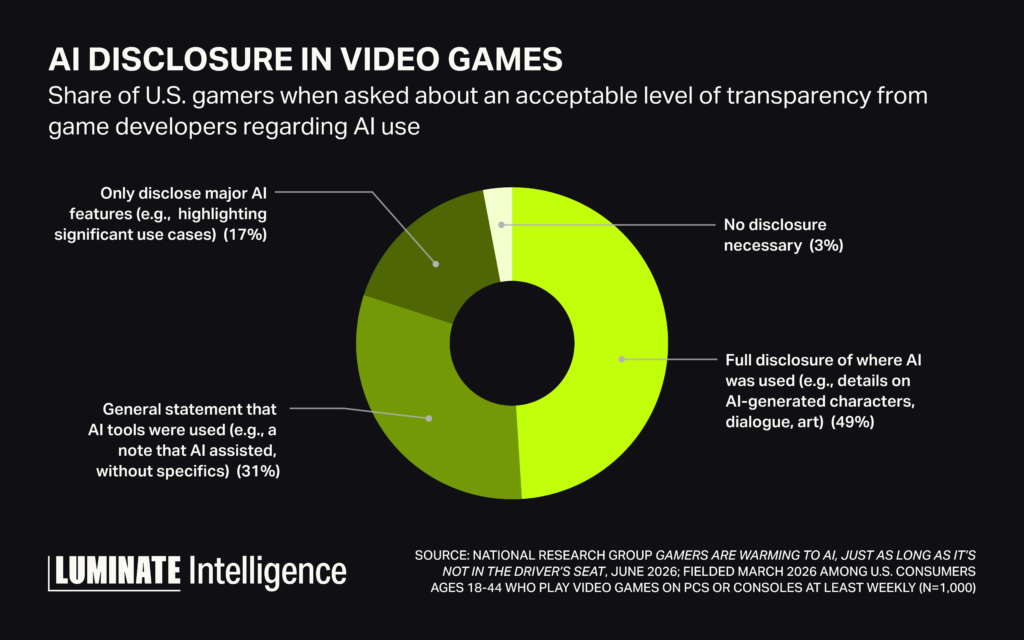
Likewise, 97% of U.S. gamers said developers should disclose AI use in video game production in some way, according to National Research Group. Opinions differed on the specificity of disclosure deemed necessary and creative contributions by AI that would merit disclosing.
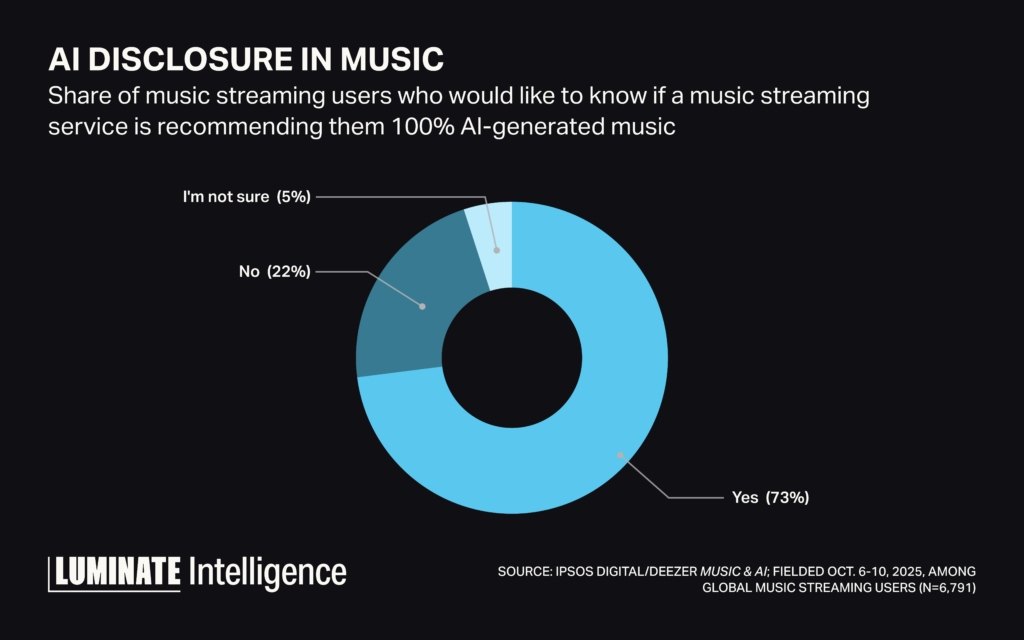
Nearly three-quarters of music streaming users want to know if a music streaming service is recommending them 100% fully AI-generated music, according to an Ipsos survey commissioned by France-based DSP Deezer.
It’s also worth noting that this is the perspective respondents held after 97% failed to distinguish between fully AI-generated music and human-made music in a blind test with two AI songs and one real song. Further, 52% felt uncomfortable with not being able to tell the difference.
Yet transparency remains a key question that’s still largely open and isn’t likely to be one size fits all for different media. For their part, film, TV and game studios will need to track AI use on projects and define best practices around how and where to disclose the role of AI in the creative process.
For music, transparency is a more immediate, consequential and technically complicated concern, as large numbers of AI tracks have been uploaded to DSPs and accumulated streams, often without users’ knowledge. At least some responsibility to disclose is likely to fall to the DSPs to consistently label tracks.
On that front, key players in the music industry have begun to take or signal action on approaches to identify and subsequently label AI songs for music listeners. Several DSPs, including Deezer, Spotify and Apple Music, have already taken steps to disclose to users when a track is AI generated or contains AI-generated material, though each differs in its preferred approach to detection and labeling, as discussed in June in the Luminate Intelligence blog post “How Music Streaming Services Are Managing AI Content.”
There are signs the industry wants a more unified approach. Earlier this month, a coalition of music industry trade groups led by the Recording Industry Association of America (RIAA) and the International Federation of the Phonographic Industry (IFPI) proposed a labeling system with associated tags for either AI-generated or AI-assisted music recordings that DSPs could display on tracks.
For further findings on consumer sentiment regarding AI use in the creation of music, film and TV, click into our new special report, here.