Ever since it first emerged from the Bronx circa 1973, Hip-Hop has been a genre where regionality plays a big role in its sound. New York is all about style and the attitude that has come to define what Hip-Hop is globally. L.A. is bold, proudly local and unafraid to blur genre lines, Atlanta is the home of Trap, Chicago Drill is all about nerve, DMV rap is brash and eccentric … and the list goes on.
Even as the Hip-Hop we know today is popular all over the world, Luminate music consumption data shows that local scenes and communities still play major roles in supporting and amplifying global artists.
As part of this sense of regional pride in Hip-Hop, artists who break through in the mainstream often maintain close ties to their local scenes. Luminate CONNECT data highlights this fact: Streaming consumption index scores show how artists including Kendrick Lamar and Ice Spice are streamed at higher rates in their respective hometowns than the national U.S. On-Demand Audio (ODA) streaming average. (Note: An index score of 1 means the artist’s local streaming consumption is equal to their national rate.)
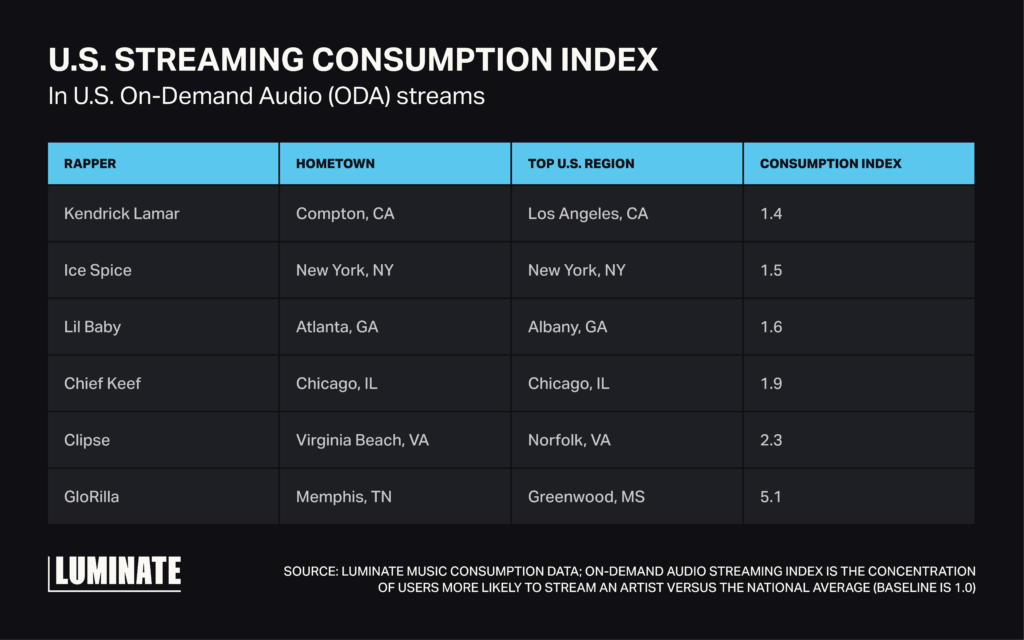
Clipse, off the heels of comeback album Let God Sort Em Out, is streamed nearly twice as much as the national average in Norfolk, Virginia — a 20-minute drive from the sibling duo’s hometown of Virginia Beach — while Memphis’ GloRilla is streamed five times as much down the road in Greenwood, Mississippi.
Of course, Hip-Hop has grown well beyond its scene-centric origins to inspire countless global artists and styles. And with the help of the internet and the rise of “glocalization,” many performers are finding their own worldwide followings.
Non-U.S. artists, such as Fakemink, KNEECAP and Asake have built their fanbases on the same regionality that drives domestic Hip-Hop acts, incorporating their own cultures, languages and experiences into the Hip-Hop template.

Many of these artists have come to find fans in the U.S., which encapsulates Hip-Hop’s evolution from local scene to international powerhouse. But in a surprising twist, Luminate music data analysis also suggests these international Hip-Hop acts have found particularly strong followings from the U.S. cities and regions that inspired their respective sounds.
Irish trio KNEECAP, for instance, has listed NYC rap groups Dead Prez and Wu-Tang Clan as primary influences, and sure enough, NYC listens to the duo at nearly twice the national average.
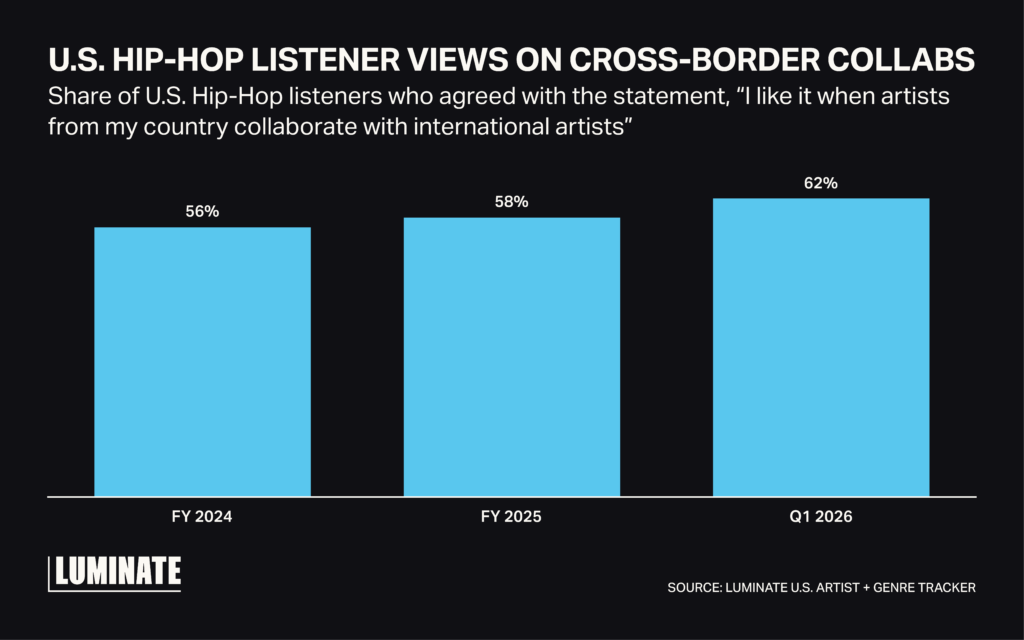
Luminate Insights data validates this trend: American Hip-Hop listeners are increasingly likely to define music as being tied to their cultural identity, jumping from 65% in 2023 to 71% in 2026, per Luminate’s U.S. Music 360 survey. Furthermore, 62% of U.S. Hip-Hop fans favor American artists collaborating with international artists.
These data trends suggest that international Hip-Hop acts might first gain notoriety via their own local scenes and online followings. But with the right co-signs and a knowledge of Hip-Hop history, bridging the gap between the global and local is a bona fide way to find connection in more genuine ways than what can normally be found in mass, online-based communities.
Brands and labels alike must pay attention to the markers that define authentic regional connection. Contact Luminate Insights to learn more about how to build these connections between artists and consumers.