
The return of two hit series late last month neatly illustrated one of streaming TV’s ongoing issues: the ideal gap between season premieres.
Netflix’s live-action Avatar: The Last Airbender adaptation dropped its second season June 25 after a more than two-year break (season 1 debuted in February 2024), while Peacock megahit Love Island USA returned for season 8 almost one year to the day after its previous season premiere (June 2 versus June 3).
Across just seven days of viewership, the contrast was already stark: Avatar’s estimated U.S. views were down 60% from S1, dropping from 6.2 million to 2.8 million. Love Island, meanwhile, more than doubled its already massive engagement season over season, averaging 5.7 million views per episode in its first week versus the previous season’s 2.3 million.
As Luminate Streaming Watch has explored previously, a long hiatus can have some beneficial effects, namely boosting engagement for past seasons as the new episodes’ premiere approaches, with viewers refreshing their memory on where things left off. Furthermore, short breaks can, at times, create a sense of overexposure and turn consumers off to a series.
But comparing long-term season performance for hit shows indicates a stark reality: A lengthy break (more than 1.5 years) is typically followed by a loss of viewers, at least in the U.S. market.
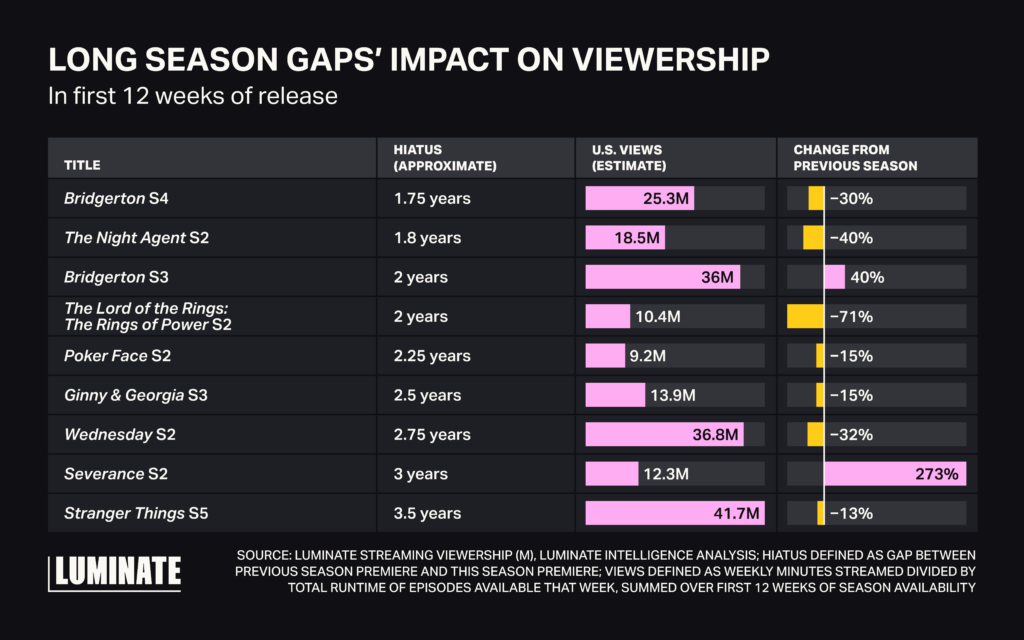
The two exceptions among a sampling of recent hits were the breakout second season of Severance, which nearly tripled its 12-week estimated views despite a three-year break, and Bridgerton Season 3, with 40% growth over S2. (The massive Severance surge was likely due to a strong marketing push by Apple TV, as well as highly positive word of mouth around season 1 and its cliffhanger ending.)
All other titles in this sample lost views (measured across their first 12 weeks of release) following a long hiatus, even top-tier streaming hits including Stranger Things (down 13% in its final season). Bridgerton Season 4 also saw a sharp reversal of fortune, posting a 30% decline from S3.
Most TV series, streaming and linear alike, tend to shed viewers the longer they run, of course — today’s breakout hit is tomorrow’s steady but unimpressive earner and next year’s also-ran — while those that grow their audiences each season are the true unicorns of the content business (e.g., Game of Thrones).
But further data indicates the newest streaming hits are united by one key quality above all else: the ability to churn out a new season every year.
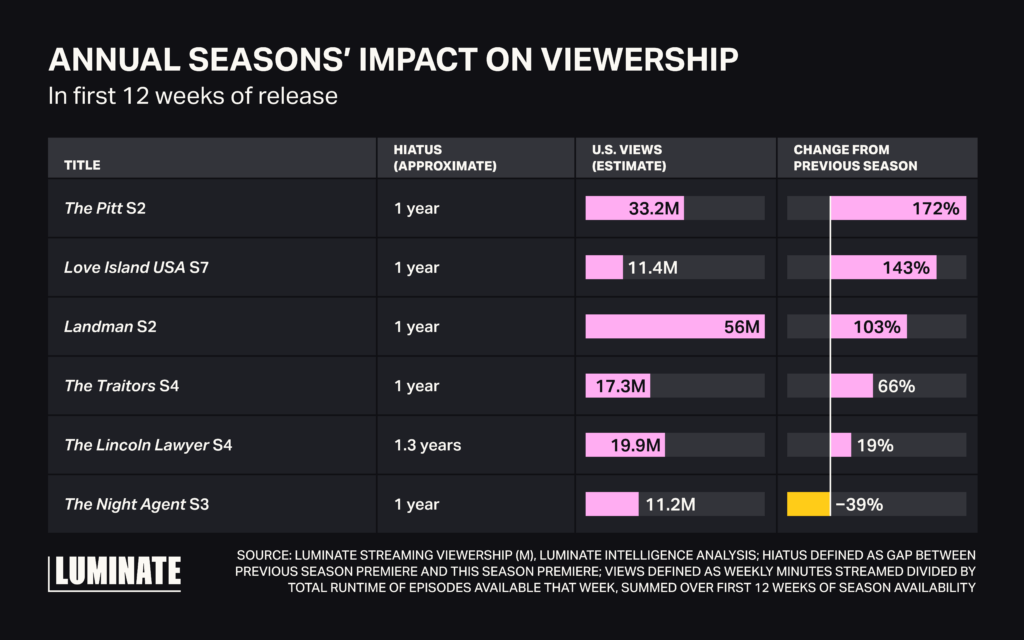
The Pitt S2, for instance, also launched almost exactly one year to the day after its predecessor and experienced a Severance-esque surge, with 172% growth in views. Paramount+ phenomenon Landman more than doubled its audience year over year as well.
Unscripted hit The Traitors, meanwhile, saw relatively modest growth but still managed to increase its audience on Peacock by nearly 70% with this year’s fourth season, finding a true breakout moment after debuting a new batch of episodes each January since 2023.
Interestingly, the lone exception among this group, Netflix’s The Night Agent, experienced a nearly 40% decline in viewership between seasons 2 and 3 despite a short gap, but this came after the show had a similar drop-off from S1 following a nearly two-year break.
In short, despite the benefits of catch-up viewing that a long hiatus can provide, consumption patterns in streaming these days indicate the key to success is an annual season premiere — just another way in which streaming hits are becoming more like old-school TV.