Saying Netflix is about to look a lot more like YouTube isn’t a snarky comment anymore but a factual statement: Just months after integrating video podcasts, the SVOD service is now adding a raft of content from popular YouTube channels that will exist on both platforms co-exclusively, as well as “some of your favorite videos from around the Internet” (per a press release) from publishers such as Buzzfeed and Conde Nast.
It’s a decisive victory for the creators involved but a more dubious move for the streamer, which famously built its brand on becoming HBO before HBO could become Netflix. But that was a long time ago, and Netflix’s new goal seems to be to become YouTube long after YouTube became YouTube.
To some degree, it’s an understandable goal. YouTube is the envy of every company in Hollywood, thanks to its commanding share of U.S. viewing time on TV screens, at least according to Nielsen’s “The Gauge.”
Despite increased scrutiny of those reports this year over perceived methodological issues, it’s still probably fair to say YouTube is the dominant force in entertainment these days, with its massive engagement generating ad revenues that dwarf those of any traditional media company.
Meanwhile, Netflix has seen its own dominance in the SVOD content space begin to ebb. Many of its biggest hits have grown long in the tooth or concluded (Stranger Things and Squid Game are already gone; Outer Banks, The Lincoln Lawyer and The Night Agent are set to end with their next season), and the newest streaming blockbusters, such as The Pitt, Love Island USA and Landman, have largely come from other services.
And while Netflix claimed six of the top 10 most-watched streaming original series in the first half of 2026 (see Luminate’s 2026 Midyear Report for more on this), all of those titles were released in March or earlier, with the platform scoring few hits in the second quarter of 2026, as analyst Entertainment Strategy Guy has pointed out.
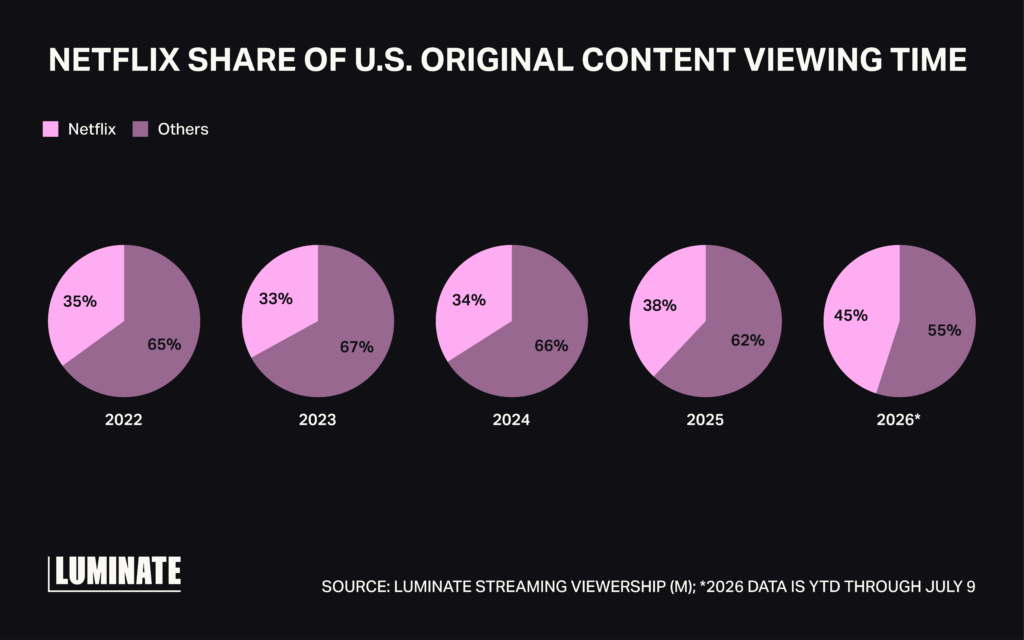
Netflix’s share of U.S. original content viewing time has accordingly dropped from 65% in 2022 to just 55% year to date in 2026, according to Luminate Streaming Viewership (M). On a global level, its overall engagement has essentially plateaued, growing just 2% year over year in H1 2026, per the streamer’s own data.
This flagging viewership has helped contribute to a sagging stock price in the wake of the company’s attempted Warner Bros. acquisition and sent Netflix scrambling for strategies to boost engagement and revenue quickly, with YouTube-esque programming evidently being a key tactic.
But in trying to at least partially re-create YouTube’s viewing ecosystem, Netflix leadership is making a flashy engagement play that is unlikely to ease its headaches.
True, certain YouTube-originated titles have found huge success on the platform, notably Cocomelon and Ms. Rachel (the latter streamed for more than 200 million hours in H1, Netflix data reported). But these titles are aimed at preschool-age children, who don’t make their own viewing decisions; a better bellwether is the popular, adult-oriented animated series The Amazing Digital Circus.
Since that show was licensed to Netflix in 2024, it has appeared on the platform’s global top 10 list just four times, according to public-facing data tracked by “What’s on Netflix.” The series racked up 3.7 million global estimated views across the entire series in the two weeks since its final episodes became available in June and 10.4 million total in the first half of the year. Over on YouTube, the final episode alone had accumulated 77 million views as of July 15 after less than a month of availability.
For many consumers, watching their favorite creators on YouTube is a deeply ingrained habit Netflix will be hard-pressed to break. If, on the other hand, the intention is to introduce these creators to new audiences via prominent Netflix placement, one wonders how large the audience for, say, Good Mythical Morning that hasn’t already found the show on YouTube really is. (Nor would this make much sense as a strategy to boost Netflix engagement.)
Furthermore, podcasts on Netflix have been off to a sluggish start; a Luminate analysis found The Breakfast Club, reportedly the most popular licensed podcast on the platform, was notching fewer than 2,000 estimated daily views.
The only podcast to be broken out in Netflix’s H1 2026 engagement report was FIFA World Cup recap show The Rest Is Football, which unlike other licensed podcasts was produced as a Netflix-exclusive video version. Per Netflix engagement report standards, this suggests no other podcast episodes managed to crack 50,000 views in the first six months of the year.
Ultimately, it’s worth asking whether these strategies are just distractions from where Netflix’s focus should really be: films and TV shows. Clearly, the streamer’s content hasn’t been resonating as strongly with audiences lately (KPop Demon Hunters aside). With most of its biggest hits now waning, shouldn’t Netflix be laser focused on developing new smash hits to replace them?
This is much easier said than done, of course, but as the new model for streaming hits becomes ever clearer — annual seasons, old-fashioned TV storytelling, not necessarily expensive — Netflix may be better served following this playbook than trying to run YouTube’s.