2026 is shaping up to be the year that nostalgia dominates pop culture.
Over the past year, viral memes on social media ranged from the ubiquitous “2026 is the new 2016” — which had consumers reminiscing about what they loved most a decade ago — to celebrities sharing their 1990s-era photos. Some of the biggest songs released in 2026 are evident throwbacks to the 1990s and Y2K. Reboots and revivals of beloved properties have flooded both big and small screens.
Consumption and survey data can arm brands and marketers with the consumer insights that help them tap into this golden age of cultural nostalgia.

One signal that nostalgia is a meaningful factor in media consumption is that consumer interest in listening to older music has incrementally increased in recent years. For each generation, a greater share of music listeners now say they enjoy listening to music from past decades versus 2023.
Naturally, older consumers are much more likely to enjoy listening to older music, with Boomers the most likely, followed in order of birth by Gen X, Millennials and Gen Z. This makes sense given that consumers tend to form their music preferences when they’re young and carry them throughout their lives.
Yet while older consumers are more inclined to listen to older music, nostalgic music listening isn’t reserved for older generations. Luminate data suggests young adults “age into” nostalgic listening and, in fact, are the most likely to pursue nostalgic feelings through music. Even compared with older generations, U.S. music listeners ages 18-34 are the most likely to say they play music to set a nostalgic mood, per Luminate’s Music 360 survey.
Understanding how nostalgic media engagement overlaps with consumer purchase intent and behaviors can help brands determine when and how to lean into nostalgia.
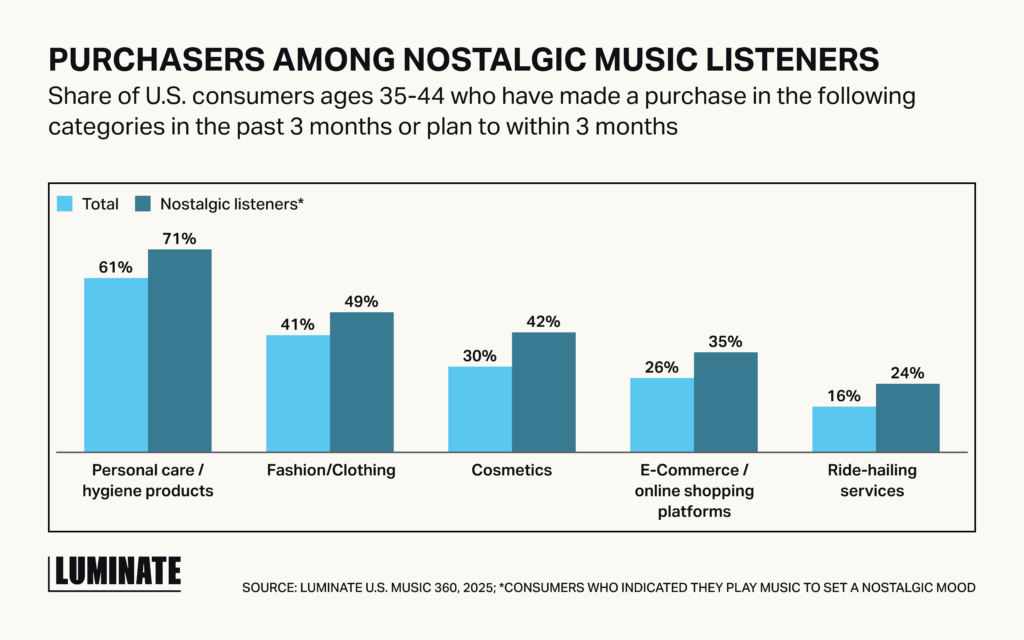
Nostalgic music listeners — consumers who say they play music to set a nostalgic mood — may be more prevalent and inclined to buy within certain product categories. For example, nostalgic music listeners ages 35-44 are more likely than consumers overall to have made a recent purchase or plan to in multiple product categories, with the largest point gaps for cosmetics and personal care/hygiene products.
Brands can also zero in on which decade of music their target consumers are most likely to enjoy. For example, casinogoers and household cleaning product purchasers are more likely to prefer music from the 1980s or earlier than prefer other decades. Telecom intenders tend to prefer 1990s and 2000s music, while gadget lovers are most interested in 2010s and current music.
For more insights on how marketers can take advantage of data that enables them to capitalize on the power of nostalgia in music and entertainment, download the free report here.